Not every business has enough cargo to fill a full shipping container. Maybe you’re exporting a first order to a European buyer, sending samples to a distributor in Latin America, or shipping household and commercial goods in quantities that don’t justify booking an entire container. Paying for space you won’t use is the problem groupage shipping was built to solve.
Groupage, also called LCL (less than container load), lets you ship only the space your cargo needs while sharing the container with other shippers’ goods. Here’s a practical guide to how LCL shipping from Jeddah works, what affects the cost, and how to prepare your shipment so it moves smoothly to Europe and Latin America.
What Is a Groupage (LCL) Shipment?
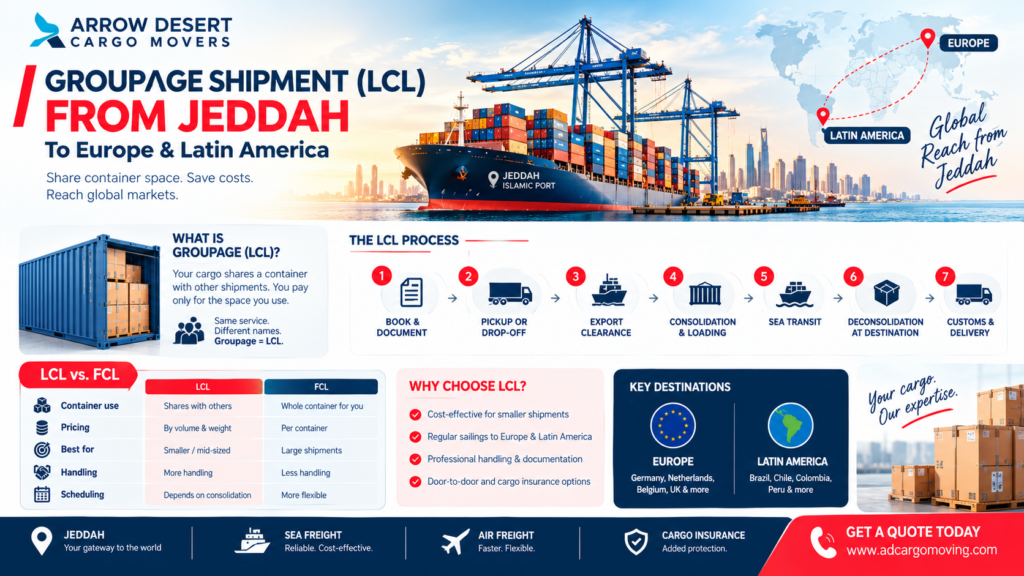
In a groupage shipment, a freight forwarder collects cargo from several different shippers heading to the same destination region and combines (consolidates) it into one container. Each shipper pays only for the space their cargo occupies. At the destination, the container is opened, the cargo is separated (deconsolidated), and each consignment continues to its own receiver.
The term “groupage” is widely used across the Middle East and Europe, while “LCL” is the more common term in international shipping. They describe the same service.
LCL vs. FCL: Which Is Right for Your Cargo?
Factor | LCL (Groupage) | FCL (Full Container) |
Container use | Your cargo shares a container with other shippers’ goods | The whole container is reserved for your cargo alone |
Pricing basis | Charged by the volume and weight your cargo actually occupies | Charged per container, whether or not it is completely full |
Best suited for | Smaller or mid-sized shipments that don’t fill a container | Large shipments that fill most of a container |
Handling | Cargo is consolidated at origin and separated at destination, so it is handled more often | Loaded once at origin and typically opened at destination |
Scheduling | Depends on the consolidation schedule for your route | More flexible, since you control when the container is packed and sealed |
Packaging needs | Needs sturdy packing and clear labeling because of the extra handling | Still needs good packing, with somewhat less handling exposure |
As a general rule, LCL makes sense when your cargo takes up a fraction of a container. As volumes grow, the cost advantage narrows, and a full container may offer better value and more control over timing. A good forwarder will compare both options for your specific shipment rather than defaulting to one.
How LCL Shipping From Jeddah Works, Step by Step
- Share your cargo details. Provide the type of goods, dimensions, weight, number of packages, and destination. This is what your forwarder uses to prepare an accurate quote.
- Cargo pickup or drop-off. With door-to-door service, your cargo is collected from your premises. Otherwise, you deliver it to the forwarder’s consolidation point.
- Export documentation. The forwarder prepares or checks the paperwork required to export the cargo from Saudi Arabia, including the commercial invoice, packing list, and bill of lading.
- Consolidation and loading. Your cargo is combined with other consignments bound for the same region and loaded into a shared container.
- Sea transit. The container is shipped by sea to the destination port. Routing and transit time depend on the destination and the shipping schedule.
- Deconsolidation at destination. The container is opened, and each consignment is separated and processed individually.
- Destination customs and delivery. Your cargo clears customs in the destination country and, with door-to-door service, is delivered to the receiver’s address.
What Affects the Cost of LCL Shipping?
LCL is priced differently from a full container, so it helps to understand what you’re paying for.
LCL is priced differently from a full container, so it helps to understand what you’re paying for.
Chargeable Volume
LCL freight is generally charged on the greater of your cargo’s volume (in cubic meters, or CBM) or its weight, using the standard rule that one cubic meter is treated as roughly one tonne. Dense, heavy cargo is therefore charged by weight, while light, bulky cargo is charged by volume. Accurate measurements matter, because errors found at the warehouse can change the final invoice.
Typical Cost Components
- Ocean freight for the space your cargo occupies
- Origin handling, consolidation, and documentation charges
- Export customs handling
- Destination handling and deconsolidation charges
- Import duties and taxes in the destination country, paid by the receiver or as agreed
- Optional services such as door-to-door delivery and cargo insurance
Always ask for an itemized quote that shows which of these are included, so there are no surprises after your cargo has shipped.
Door-to-Door, Consolidated Freight, and Documentation Support: What They Mean in Practice
Door-to-Door Solutions
Instead of arranging separate trucking at each end, a door-to-door service covers pickup from your premises through to delivery at the receiver’s address. For smaller shippers without their own logistics team, this removes a lot of coordination.
Consolidated Sea Freight
Consolidation is what makes LCL cost-effective. By pooling cargo from multiple shippers into one container, the freight cost is shared, which makes sea freight accessible for shipments that would be uneconomical as a full container.
Export Documentation and Customs Support
Paperwork errors are one of the most common causes of shipment delays. A forwarder that handles export documentation and customs coordination helps make sure your cargo is cleared correctly before it leaves Saudi Arabia and is properly documented for the destination
Documents You’ll Typically Need
- Commercial invoice describing the goods and their value
- Packing list showing contents, quantities, weights, and dimensions
- Bill of lading, issued as the transport document for the shipment
- Certificate of origin, where the destination or buyer requires one
- Product-specific certificates or permits for regulated goods
- Any import documentation required by the destination country
Requirements vary by destination and by product type, so confirm the exact list with your forwarder before shipping.
How to Prepare Your LCL Cargo
- Pack for extra handling. Because LCL cargo is consolidated and separated along the way, use strong cartons, crates, or pallets that can withstand being moved several times.
- Palletize where possible. Pallets make loading faster and protect goods from damage.
- Use compliant wood packaging. If you use wooden pallets or crates, check that they meet international treatment requirements for wood packaging, since untreated wood can cause problems at destination ports.
- Label every package clearly. Include the receiver’s name, address, and shipment reference on every package so nothing gets separated from its consignment.
- Measure and weigh accurately. Precise dimensions and weights give you a reliable quote and avoid invoice adjustments.
- Consider cargo insurance. LCL cargo changes hands more often, so insurance is worth discussing, especially for high-value goods.
Questions to Ask Before You Book
- How often does the consolidation to my destination depart, and what is the cut-off date for my cargo?
- What is the estimated transit time to my destination, and does it include transshipment?
- Is the quote itemized, and which charges are not included?
- Who handles customs clearance and destination delivery?
- What happens if my cargo is held for inspection or documents are incomplete?
- Are there any restrictions on the goods I want to ship, such as dangerous goods?
A Note on Shipping Schedules
Global shipping routes have faced disruption in recent years, including around the Red Sea. Depending on the lane, this can affect routing and schedule reliability. Because LCL depends on consolidation schedules, it’s wise to ask your forwarder for current transit estimates and to build in some buffer time, particularly for time-sensitive orders.
For businesses and individuals shipping smaller volumes, LCL shipping from Jeddah offers a practical, cost-effective way to send cargo to Europe and Latin America without paying for an entire container. Understanding how groupage shipment works, from consolidation and documentation to destination delivery, helps you prepare your cargo properly, compare quotes accurately, and avoid the delays that catch first-time shippers off guard.
At Arrow Desert Cargo Movers, we provide consolidated sea freight, door-to-door solutions, and export documentation and customs support for cargo leaving Jeddah. Book your shipment today at www.adcargomoving.com or call 055 117 5557 to discuss your cargo and get a clear, itemized quote from a trusted logistics company in Jeddah.