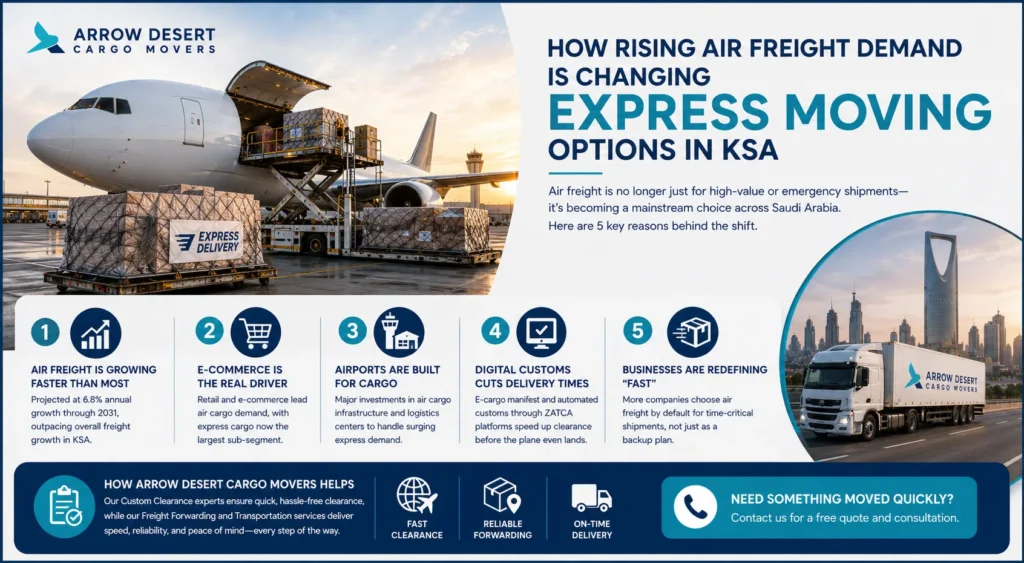
1. Air Freight Is Growing Faster Than Almost Any Other Mode
While road transport still carries the largest share of freight in Saudi Arabia, industry forecasts put air freight’s growth rate well ahead of the market average — projected at close to a 6.8% annual growth rate through 2031, outpacing overall freight and logistics growth in the Kingdom. Saudi Arabia already holds the largest share of the GCC’s air freight market, driven by its central position between Asia, Europe, and Africa. In plain terms: air is becoming the fastest-growing way to move goods in and out of the country, not a niche option, reflecting the steady rise in air freight demand.
2. E-Commerce Is the Real Driver
The single biggest force behind this growth isn’t industrial cargo — it’s online shopping. Retail and e-commerce are consistently identified as the leading end-users of Saudi air cargo, and express cargo (fast, time-critical shipments) is now the dominant sub-segment of the entire air cargo market. As more people expect two- or three-day delivery on everything from electronics to specialty goods, carriers are shifting capacity toward exactly that kind of express, time-sensitive freight.
3. Airports Are Being Built for Cargo, Not Just Passengers
Saudi Arabia has committed tens of billions of dollars toward expanding logistics infrastructure, and a meaningful part of that is aimed squarely at air cargo. Riyadh’s airport alone is being expanded toward a six-runway capacity, and the Kingdom has earmarked major investment for new logistics centers across the country. This isn’t incidental – it’s a deliberate bet that air freight demand and cargo volume, especially express and e-commerce shipments, will keep climbing for years.
4. Digital Customs Processing Is Cutting Delivery Times
One of the quieter but more important changes is digital. Programs like the General Authority of Civil Aviation’s e-cargo manifest system now allow shipments to be cleared electronically before the aircraft even lands, reducing the dwell time that used to sit between “the plane landed” and “your shipment is actually available.” Combined with automated customs declarations through the ZATCA/FASAH platform, the paperwork side of express shipping is getting noticeably faster — which matters just as much as flight speed itself.
5. Businesses Are Rethinking What "Fast" Means
With sea freight still facing route disruptions and rail infrastructure like the Landbridge still years from full operation, more businesses — especially in retail, pharmaceuticals, and high-tech imports — are treating air freight as their default option for anything time-critical, rather than an expensive backup plan. That shift in mindset is arguably as important as the infrastructure itself, especially as air freight demand continues to grow.
What This Means for Express Moving and Shipping in KSA
- Faster turnaround on international shipments and relocations — for both individuals moving belongings quickly and businesses needing urgent inventory or equipment.
- More scheduling flexibility, as airlines and cargo handlers add frequency to meet e-commerce and express demand.
- Growing importance of a partner who can navigate digital customs clearance efficiently — since the paperwork, not the flight, is often what determines how “express” your express shipment really is.