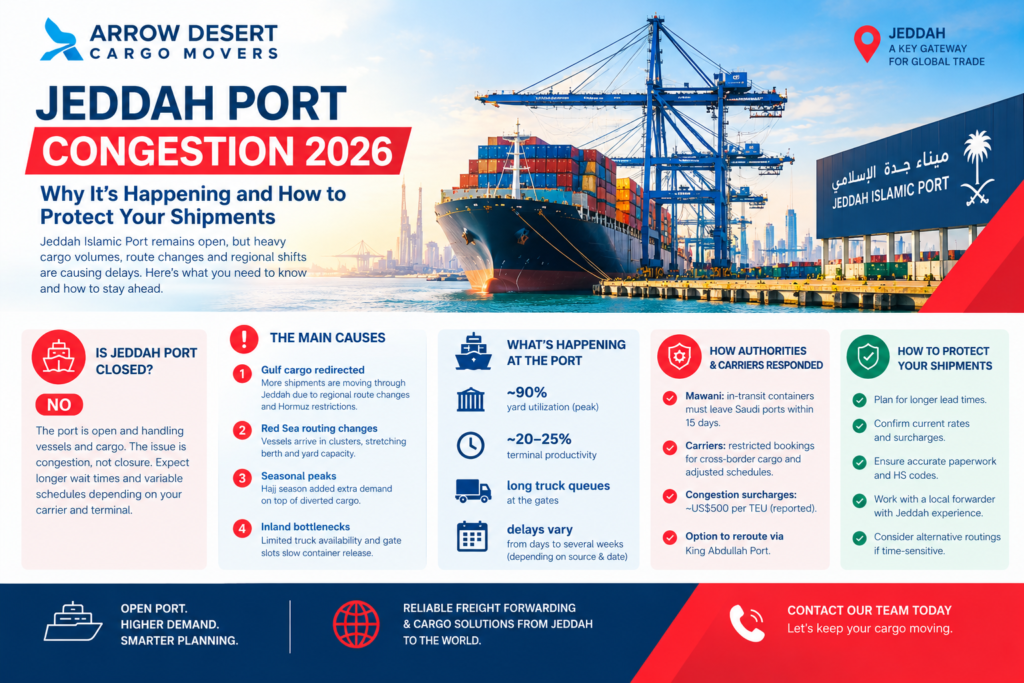
If you’ve been waiting longer than usual for a container to be released at Jeddah, or your trucking company can’t find a slot, you’re not imagining it. Jeddah Islamic Port, normally the main gateway for goods entering western Saudi Arabia, has been under heavy pressure through 2026, and the effects are reaching importers, exporters, retailers, and families waiting on shipped belongings.
Here’s a clear, practical look at what’s going on, why it’s happening, and what you can do to protect your shipments and your timelines.
Key Takeaways
- Jeddah Islamic Port is operating, but heavy congestion is slowing container release, truck turnaround, and inland delivery.
- The main driver is cargo for the wider Gulf being redirected through Saudi Red Sea ports and overland routes, on top of Red Sea routing changes.
- Carriers and the Saudi Ports Authority (Mawani) have introduced restrictions, surcharges, and rerouting options.
Plan for longer lead times, confirm demurrage terms, and ask your forwarder for current, shipment-specific guidance.
Is Jeddah Port Closed?
No. Based on shipping industry updates, Jeddah Islamic Port remains open and continues to handle vessels and cargo. The problem is congestion, not closure. Individual shipments may experience delays depending on the carrier, the terminal, and the inland transport arrangements, but cargo destined for Saudi Arabia is still being received and moved by road to cities across the Kingdom.
That distinction matters for planning. A closed port means rerouting everything. A congested port means building in more time, tightening your paperwork, and managing costs.
What’s Happening at the Port
Industry reports through the summer described a port running close to the limit of its yard capacity. Around July, estimates put yard utilization near 90% and terminal productivity down by roughly a fifth to a quarter, with long truck queues at the gates. Carriers including Maersk have reported elevated cargo flows through Jeddah and King Abdullah Port, leading to longer container collection and truck turnaround times.
Reported delays vary widely depending on the source, the date, and the shipment. Some accounts describe container release stretching to several weeks at the peak, while others cite days rather than weeks. The practical takeaway is that timelines are unpredictable, so treat any quoted figure as a snapshot and get a current estimate for your specific shipment.
One more nuance: congestion isn’t only about ships waiting to berth. Vessel waiting times at the port have fluctuated, but the bigger bottleneck has been what happens after cargo is discharged, including container release, terminal gate processing, and inland trucking.
Why Jeddah Is Congested: The Main Causes
1. Gulf Cargo Is Being Redirected Through Saudi Arabia
The biggest factor is regional. Restrictions on shipping through the Strait of Hormuz have disrupted the normal route for cargo bound for Gulf destinations. In response, shipping lines and forwarders have moved cargo to Red Sea gateways such as Jeddah and King Abdullah Port, then onward by land bridge to other countries in the region, including the UAE, Kuwait, and the wider GCC.
The result is that Jeddah has been absorbing volumes it was never designed to handle on top of its normal job of serving the Western Province. Ports on the Gulf side that depend on passage through Hormuz, including Dammam, have also been affected by the restrictions, which has added to the pressure on Red Sea alternatives.
2. Red Sea Routing Changes
Changes to shipping routes around the Red Sea and Bab el-Mandeb have caused vessels to arrive in clusters rather than spread evenly. That stretches berth and yard capacity and makes schedules less reliable for the feeder services that connect Jeddah to other ports.
3. Seasonal Peaks on Top of Diverted Volume
Earlier in the summer, the Hajj season added further demand on the port and the roads around it, compounding the volume already being diverted.
4. Inland Bottlenecks
Even when a container is cleared, getting it out of the port requires a truck, a driver, and a slot at the gate. High demand has strained truck availability, and the delay at that stage feeds back into the yard, keeping it fuller for longer.
How Authorities and Carriers Have Responded
- The Saudi Ports Authority (Mawani) introduced a rule requiring in-transit containers to leave Saudi ports within 15 days of arrival, to keep yards from clogging with cargo bound for other countries.
- Several carriers paused or restricted bookings for cross-border and in-transit cargo moving through Jeddah, and some adjusted schedules or omitted Jeddah calls altogether.
- Some lines, including MSC, announced congestion surcharges for Jeddah-bound cargo, reported at around US$500 per TEU, and offered customers the option to reroute through King Abdullah Port.
- Hapag-Lloyd announced an additional premium on dangerous-goods containers bound for Jeddah from North Europe and the Mediterranean, reported at US$1,000 per container.
- Carriers and forwarders have increasingly pointed importers toward alternatives such as King Abdullah Port, located north of Jeddah along the Red Sea coast.
These measures change over time, and they vary by carrier and trade lane. Your forwarder should be able to tell you which apply to your booking.
What This Means for Businesses and Families in Jeddah
Impact | What You Can Do |
Slow container release | Build extra weeks into delivery timelines and confirm expected release times with your forwarder before you ship. |
Demurrage and detention risk | Check free-time terms in writing, and ask who bears charges when the delay is caused by port congestion. |
Limited truck availability | Book inland trucking early and share accurate cargo details so the right vehicle is assigned. |
Added surcharges | Ask for an itemized quote and confirm whether carrier congestion or special-cargo surcharges apply to your booking. |
Inventory gaps | Order earlier, hold extra safety stock for critical items, and stagger shipments instead of relying on a single arrival. |
Relocation timing | Don’t tie your move-in date to a container arrival date. Arrange temporary storage or a buffer period. |
A Practical Playbook for Protecting Your Shipments
- Get current, shipment-specific guidance. Ask your forwarder for expected release and delivery times for your carrier, terminal, and cargo type, rather than relying on pre-2026 transit assumptions.
- Build in a buffer. Add extra time between arrival and the date you actually need the goods, especially for production inputs, retail stock, or anything tied to a launch or deadline.
- Confirm demurrage and detention terms. Know how many free days you have, what the daily charges are, and what happens when delays are outside your control.
- Get your paperwork right the first time. Accurate HS codes, complete commercial documents, and any required certifications reduce the chance of additional holds on top of port delays.
- Line up trucking early. With truck availability tight, advance booking and accurate cargo details help you secure a slot as soon as your container is released.
- Discuss alternative routing. Ask whether King Abdullah Port or another gateway makes sense for your cargo, and what it would add in trucking cost and time. It won’t suit every shipment.
- Split or stagger shipments. For critical items, avoid putting everything on a single vessel or arrival date.
- Consider air freight for urgent items. For small, high-value, or time-critical goods, the extra cost may be worth avoiding a long wait.
- Review insurance and communicate early. Check cargo insurance coverage for delays and damage, and let your customers know about realistic delivery windows before problems arise.
Moving or Relocating? What It Means for Your Shipment
If your household goods or business equipment are arriving by sea, congestion can push delivery dates back by weeks. Avoid scheduling your final move-in or opening date to match a container’s estimated arrival. Instead, plan a buffer period, arrange temporary storage if needed, and keep essentials with you so you aren’t stuck waiting on a container to settle in.
The same applies to exports. If you’re sending cargo out through Jeddah, whether as a full container or a groupage (LCL) consolidation, check cut-off dates and sailing schedules early, since carrier schedule changes can affect when your cargo actually departs.
What to Watch Going Forward
- Announcements from the Saudi Ports Authority (Mawani) about in-transit rules and port operations.
- Carrier advisories on surcharges, booking restrictions, and routing changes.
- Updates on conditions affecting the Strait of Hormuz and Red Sea shipping lanes, which drive diverted volumes.
- Your forwarder’s own operational updates, which reflect conditions on the ground at the port that day.
Conditions are changing quickly, so check for current information before making commitments that depend on port timelines.
Frequently Asked Questions
Is Jeddah Islamic Port closed?
No. The port remains operational and continues to receive cargo for Saudi Arabia, but it is experiencing significant congestion that is slowing container release and inland delivery.
Why is Jeddah Port so congested?
The main reason is that cargo for other Gulf destinations has been redirected through Saudi Red Sea ports and land routes because of restrictions on shipping through the Strait of Hormuz. Red Sea routing changes, seasonal demand, and trucking bottlenecks have added to the strain.
How long are the delays?
It depends on the carrier, terminal, cargo type, and timing. Reports have ranged from days to several weeks at the worst points. Ask your forwarder for a current estimate for your shipment.
Can I ship through King Abdullah Port instead?
Some carriers allow rerouting through King Abdullah Port, and it has been suggested as an alternative. Whether it makes sense depends on your destination, trucking costs, and the carrier’s terms, so discuss it with your forwarder before deciding.
Does the congestion affect cargo leaving Saudi Arabia?
It can. Schedule changes, rollovers, and carrier restrictions may affect export bookings and sailing dates, so confirm cut-offs and schedules early.
The Jeddah port congestion is real, but it isn’t a closure. Cargo redirected from the wider Gulf, Red Sea routing changes, and trucking bottlenecks have combined to slow container release and push costs up, and the businesses coping best are the ones planning for it: building buffers, confirming terms, getting paperwork right, and talking to their forwarders early about alternatives such as King Abdullah Port.
At Arrow Desert Cargo Movers, we follow port conditions closely so our clients aren’t caught off guard. Contact our team today at www.adcargomoving.com or call 055 117 5557 for current guidance on your shipment from a logistics company in Jeddah that deals with these conditions every day.