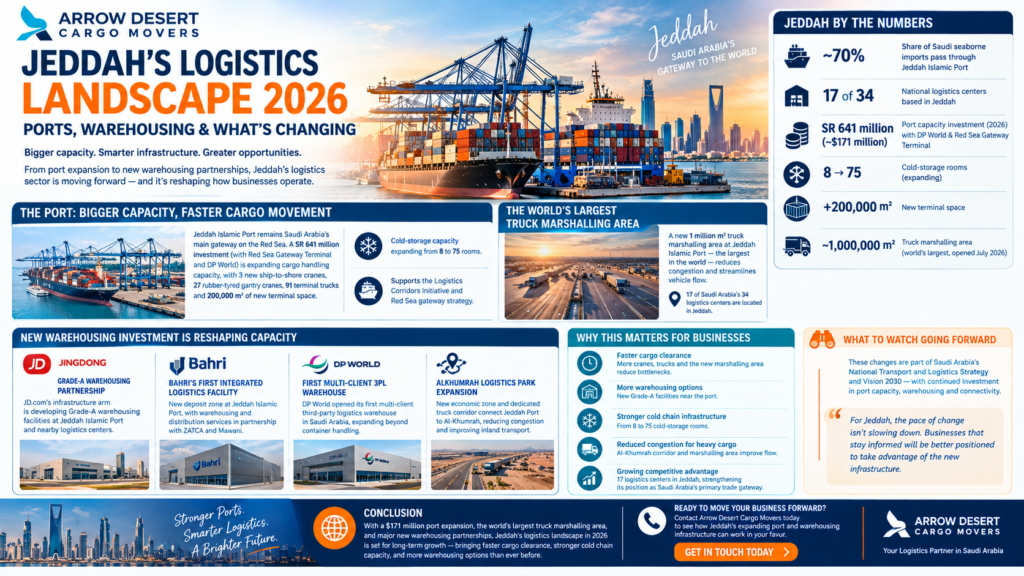
Jeddah has always been Saudi Arabia’s gateway to the world. But 2026 has brought a wave of investment and infrastructure change that’s reshaping the city’s logistics landscape faster than at almost any point in recent memory — new warehousing partnerships, a major port capacity expansion, and one of the largest truck logistics facilities on the planet, all within the same year.
For any business operating in or around Jeddah, understanding these changes isn’t optional background reading. It directly affects import timelines, warehousing options, and how competitive the city’s logistics sector is becoming. Here’s a clear snapshot of where things stand.
Jeddah by the Numbers
Metric | 2026 Figure |
Share of Saudi seaborne imports | ~70% pass through Jeddah Islamic Port |
National logistics centers based in Jeddah | 17 of Saudi Arabia’s 34 logistics centers |
Port capacity investment (2026) | SR 641 million (~$171 million) with DP World & Red Sea Gateway Terminal |
New cold-storage capacity | Expanding from 8 to 75 cold-storage rooms |
New terminal space | +200,000 square meters |
Truck marshalling area | ~1 million square meters — the world’s largest, opened July 2026 |
The Port: Bigger Capacity, Faster Cargo Movement
Jeddah Islamic Port remains Saudi Arabia’s principal gateway on the Red Sea, sitting on one of the world’s busiest East-West maritime trade corridors and handling the large majority of the Kingdom’s seaborne imports. In mid-2026, the Saudi Ports Authority (Mawani) announced a SR 641 million (roughly $171 million) investment to expand the port’s cargo-handling capacity, carried out in partnership with Red Sea Gateway Terminal and DP World.
The upgrade adds three ship-to-shore cranes, 27 rubber-tyred gantry cranes, 91 terminal trucks, and additional ground-handling equipment, alongside 200,000 square meters of new terminal space. Notably, cold-storage capacity at the port is expanding from just 8 rooms to 75 — a clear signal that refrigerated and temperature-sensitive cargo is becoming a much bigger priority.
This investment ties into the Kingdom’s broader Logistics Corridors Initiative, part of a wider strategy to reinforce Red Sea gateway capacity as trade volumes continue climbing.
The World's Largest Truck Marshalling Area
One of the most striking developments this year is the opening of a new truck marshalling area at Jeddah Islamic Port, spanning approximately one million square meters. Described as the largest facility of its kind in the world, it’s designed as the primary staging point for trucks entering the port before proceeding to cargo gates, aimed at reducing congestion and streamlining vehicle flow.
Saudi Ports Authority officials have also confirmed that 17 of Saudi Arabia’s 34 national logistics centers are located in Jeddah — reinforcing just how central the city is to the Kingdom’s overall logistics network, not just its western region.
New Warehousing Investment Is Reshaping Capacity
Grade-A Warehousing Partnership
In July 2026, JINGDONG Property (the infrastructure arm of JD.com) signed an agreement with Mawani to develop Grade-A warehousing facilities within Jeddah Islamic Port and surrounding logistics centers — a notable sign of international investor confidence in the city’s logistics capacity.
Bahri’s First Integrated Logistics Facility
Bahri, Saudi Arabia’s national shipping carrier, opened its first integrated logistics deposit zone at Jeddah Islamic Port in July 2026, developed in partnership with the Zakat, Tax and Customs Authority and the Saudi Ports Authority. The facility combines warehousing and distribution services aimed at streamlining trade and improving cargo movement through the port.
DP World’s First Multi-Client 3PL Warehouse in the Kingdom
DP World, which operates Jeddah’s South Container Terminal, opened its first multi-client third-party logistics warehouse in Saudi Arabia in July 2026 — expanding the port’s role from container handling into broader warehousing and distribution services.
Al-Khumrah Logistics Park Expansion
Development is also underway in the Al-Khumrah logistics area, where a new economic zone is planned to create further investment opportunities. A dedicated truck corridor now connects Jeddah Islamic Port directly to Al-Khumrah Logistics Park, reducing urban congestion and improving the movement of heavy cargo from the port to inland logistics sites.
Why This Matters for Businesses in Jeddah
- Faster cargo clearance: expanded crane capacity, more terminal trucks, and the new marshalling area should reduce the bottlenecks that have historically slowed cargo movement through the port.
- More warehousing options: with JD.com, Bahri, and DP World all adding capacity in 2026, businesses have a wider range of Grade-A storage and distribution options near the port than in previous years.
- Stronger cold chain infrastructure: the jump from 8 to 75 cold-storage rooms directly benefits businesses handling perishables, pharmaceuticals, or other temperature-sensitive goods.
- Reduced congestion for heavy cargo: the Al-Khumrah truck corridor and marshalling area both point toward smoother, faster inland transport from the port to logistics parks.
- Growing competitive advantage for the western region: with 17 of the Kingdom’s 34 logistics centers based in Jeddah, the city continues to consolidate its position as Saudi Arabia’s primary trade gateway, not just a regional hub.
What to Watch Going Forward
These developments are part of a broader pattern under Saudi Arabia’s National Transport and Logistics Strategy and Vision 2030 — continued investment in port capacity, warehousing, and inland connectivity, all aimed at cementing the Kingdom’s position as a global logistics hub connecting Asia, Europe, and Africa. For Jeddah specifically, that means the pace of change is unlikely to slow down. Businesses that stay current on these shifts, rather than assuming last year’s capacity and timelines still apply, will be better positioned to take advantage of the added infrastructure.
Jeddah’s logistics landscape has shifted meaningfully in 2026 — a $171 million port expansion, the world’s largest truck marshalling area, and major new warehousing partnerships from JD.com, Bahri, and DP World have all landed within the same year. Together, these changes point toward faster cargo clearance, stronger cold chain capacity, and significantly more warehousing options near Jeddah Islamic Port than the city has ever had. For businesses that rely on imports, storage, or distribution through Jeddah, these are exactly the kinds of infrastructure shifts worth building into long-term planning.
At Arrow Desert Cargo Movers, we track these changes closely because they directly shape how we plan cargo handling and storage for our clients. Contact our team today to talk through how Jeddah’s expanding port and warehousing infrastructure can work in your business’s favor.