For decades, if you needed to move something — or someone — between Jeddah and the other side of the Kingdom, there was really one practical answer: the highway. Trucks and moving vans have carried the vast majority of Saudi Arabia’s long-distance freight and household relocations. But that’s starting to shift, and the reason is Saudi Arabia rail network long-distance moves becoming a major part of the country’s rapidly expanding rail infrastructure.
The centerpiece is the Saudi Landbridge — a roughly 1,500-km rail corridor connecting Jeddah on the Red Sea to Dammam and Jubail on the Gulf coast, with a $7 billion-plus price tag and construction already underway. Add in five new freight corridors recently launched by Saudi Arabia Railways (SAR) linking hubs like Dammam, Jubail, Ras Al Khair, and Hail to Red Sea ports, and it’s clear rail is no longer a side project — it’s becoming core infrastructure. So what does that mean if you’re planning a long-distance move or shipment? Let’s break down how road and rail actually compare, and where each one will keep making sense.
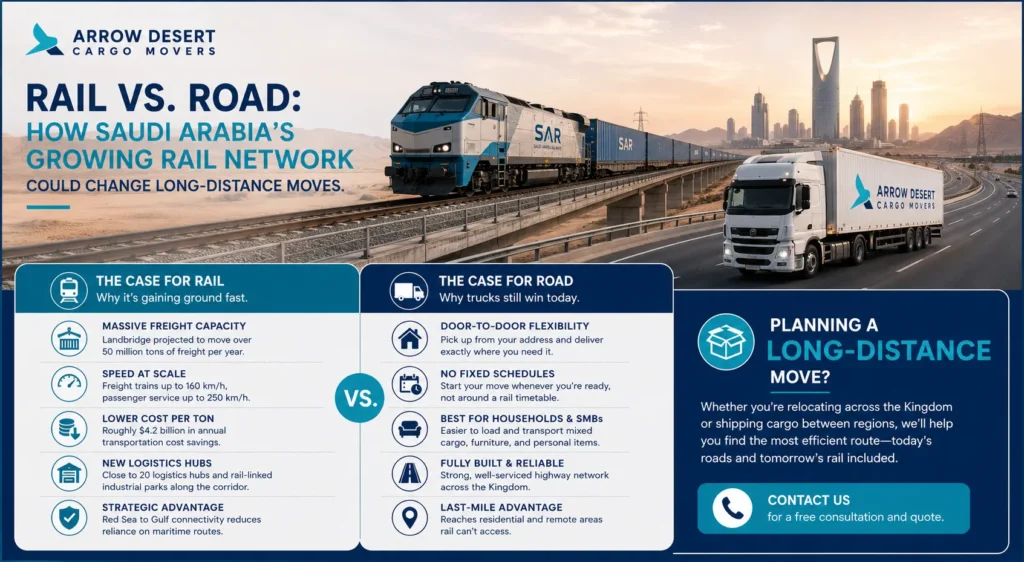
The Case for Road (Why Trucks Still Win Today)
Right now, road transport remains the backbone of long-distance moving in Saudi Arabia, and for good reason:
- Door-to-door flexibility. A truck can pick up from your exact address and drop off at your exact destination — no transfer points, no last-mile handoff.
- No dependency on fixed schedules. Road moves can start whenever you’re ready, rather than around a rail timetable.
- Better suited to household and small business moves. Furniture, personal belongings, and mixed cargo loads are easier to load, secure, and unload from a truck than to consolidate for rail freight.
- Already fully built out. The highway network connecting Jeddah to Riyadh, Dammam, Madinah, and other major cities is mature and well-serviced.
Road isn’t going anywhere — but its downsides (traffic, driver shortages reported industrywide, fuel cost swings, and longer transit on very long routes) are exactly what the new rail corridors are designed to offset.
The Case for Rail (Why It's Gaining Ground Fast)
The Landbridge and SAR’s expanding freight corridors are being built specifically to solve the problems road transport can’t:
- Massive freight capacity. The Landbridge alone is projected to move over 50 million tons of freight per year once operational, taking significant pressure off the highway network.
- Speed at scale. Freight trains on the new lines are designed to run up to 160 km/h, with passenger service reaching 250 km/h on shared corridors — a meaningful jump for long, cross-country hauls.
- Lower cost per ton over distance. Officials project roughly $4.2 billion in annual transportation cost savings once the Landbridge is fully operational, largely from shifting freight off trucks and onto rail.
- New logistics hubs along the route. The project includes close to 20 planned logistics hubs and rail-linked industrial parks, creating new inland points where goods can be consolidated, stored, and redistributed.
- Reduced reliance on maritime routes. By connecting the Red Sea directly to the Gulf overland, rail gives businesses an alternative to shipping around the Arabian Peninsula — especially valuable amid ongoing Red Sea shipping risks.
The catch: rail construction is still in progress, with priority segments moving forward in phases and full operation targeted for the late 2020s. So for the next few years, rail will be a growing option — not a full replacement for road.
What This Means for You Right Now
If you’re planning a long-distance move or shipment in Saudi Arabia today, here’s the practical takeaway:
For household moves and time-sensitive relocations, road transport is still the most direct, flexible option — and will remain so even after rail networks mature, especially for the final leg into residential areas.
For businesses shipping bulk goods, equipment, or inventory across the country, it’s worth starting to plan around rail as an emerging option, particularly once corridors linking Jeddah, Riyadh, and the Eastern Province come fully online. Locking in efficient road logistics now, with an eye toward hybrid road-rail routing later, will put you ahead of the shift.
For everyone, the smartest approach over the next few years isn’t picking one mode over the other — it’s working with a moving and logistics partner who understands both, and who can adapt your route as new infrastructure opens up.
How Arrow Desert Cargo Movers Helps You Move Smart, Not Just Fast
We keep a close eye on Saudi Arabia’s evolving logistics landscape so our clients don’t have to. Today, that means offering dependable, well-planned Transportation services for long-distance moves across the Kingdom — whether it’s a household relocating from Jeddah to Riyadh or Dammam, or a business shipping goods between regions. As rail infrastructure comes online in the years ahead, we’ll be ready to incorporate it into the most efficient route for your move, combining road and rail wherever it saves you time and money.
Long-distance doesn’t have to mean complicated. With the right partner, it just means well-planned.
Planning a Long-Distance Move?
Whether you’re relocating across the Kingdom or shipping cargo between regions, we’ll help you find the most efficient route — today’s roads and tomorrow’s rail included.
Contact Us for a free consultation and quote.